

Chuyên đề Sinh hoạt chuyên môn - Cụm từ và mệnh đề (Phrases and clauses)
 5 trang
08/11/2025
1170
5 trang
08/11/2025
1170
Bạn đang xem tài liệu "Chuyên đề Sinh hoạt chuyên môn - Cụm từ và mệnh đề (Phrases and clauses)", để tải tài liệu gốc về máy hãy click vào nút Download ở trên.
Tóm tắt nội dung tài liệu: Chuyên đề Sinh hoạt chuyên môn - Cụm từ và mệnh đề (Phrases and clauses)
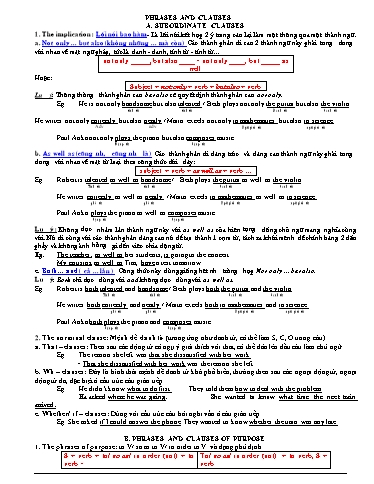
PHRASES AND CLAUSES A. SUBORDINATE CLAUSES 1. The implication: Lèi nãi bao hµm- Lµ lèi nãi kÕt hîp 2 ý trong c©u l¹i lµm mét th«ng qua mét thµnh ng÷. a. Not only ... but also (kh«ng nh÷ng ... mµ cßn) C¸c thµnh phÇn ®i sau 2 thµnh ng÷ nµy ph¶i t¬ng ®¬ng víi nhau vÒ mÆt ng÷ ph¸p, tøc lµ danh - danh, tÝnh tõ - tÝnh tõ... not only _____, but also ____ = not only ____ , but _____ as well Hoặc: Subject + not only + verb + but also + verb Lu ý: Th«ng thêng thµnh phÇn sau but also sÏ quyÕt ®Þnh thµnh phÇn sau not only. Eg. He is not only handsome but also talented./ Beth plays not only the guitar but also the violin. tÝnh tõ tÝnh tõ Danh tõ danh tõ He writes not only correctly but also neatly./ Maria excels not only in mathematics but also in science. Adv adv Ng÷ giíi tõ ng÷ giíi tõ Paul Anka not only plays the piano but also composes music. §éng tõ ®éng tõ b. As well as (còng nh, còng nh lµ) C¸c thµnh phÇn ®i ®»ng tríc vµ ®»ng sau thµnh ng÷ nµy ph¶i t¬ng ®¬ng víi nhau vÒ mÆt tõ lo¹i theo c«ng thøc díi ®©y: subject + verb + as well as + verb ... Eg. Robert is talented as well as handsome./ Beth plays the guitar as well as the violin. TÝnh tõ tÝnh tõ ®anh tõ danh tõ He writes correctly as well as neatly. / Marta excels in mathematics as well as in science. phã tõ phã tõ Ng÷ giíi tõ ng÷ giíi tõ Paul Anka plays the piano as well as composes music. ®éng tõ ®éng tõ Lu ý: Kh«ng ®îc nhÇm lÉn thµnh ng÷ nµy víi as well as cña hiÖn tîng ®ång chñ ng÷ mang nghÜa cïng víi. Nã ®i cïng víi c¸c thµnh phÇn ®»ng sau nã ®Ó t¹o thµnh 1 côm tõ, t¸ch ra khái mÖnh ®Ò chÝnh b»ng 2 dÊu phÈy vµ kh«ng ¶nh hëng g× ®Õn viÖc chia ®éng tõ. Eg. The teacher, as well as her students, is going to the concert. My cousins, as well as Tim, have a test tomorrow. c. Both ... and ( c¶ ... lÉn ) C«ng thøc nµy dïng gièng hÖt nh trêng hîp Not only ... but also. Lu ý: Both chØ ®îc dïng víi and kh«ng ®îc dïng víi as well as. Eg. Robert is both talented and handsome./ Beth plays both the guitar and the violin. TÝnh tõ tÝnh tõ ®anh tõ danh tõ He writes both correctly and neatly./ Marta excels both in mathematics and in science. phã tõ phã tõ Ng÷ giíi tõ ng÷ giíi tõ Paul Anka both plays the piano and composes music. ®éng tõ ®éng tõ 2. The norminal clause: Mệnh đề danh từ (tương ứng như danh từ, có thể làm S, C, O trong câu) a. That – clauses: Theo sau các động từ có ngụ ý giải thích với that, có thể đảo lên đầu câu làm chủ ngữ. Eg. The reason she left was that she dissatisfied with her work. = That she dissatisfied with her work was the reason she left. b. Wh – clauses: Đây là hình thái mệnh đề danh từ khá phổ biến, thường theo sau các ngoại động từ, ngoại động từ đa, đặc biệt ở cấu trúc câu gián tiếp. Eg. He didn’t know what to do first. They told them how to deal with the problem. Ha asked where he was going. She wanted to know what time the next train arrived. c. Whether/ if – clauses: Dùng với cấu trúc câu hỏi nghi vấn ở câu gián tiếp. Eg. She asked if I could answer the phone. They wanted to know whether the train was any late. B. PHRASES AND CLAUSES OF PURPOSE 1. The phrases of purpose: to V/ so as to V/ in order to V và dạng phủ định S + verb + to/ so as/ in order (not) + to To/ so as/ in order (not) + to verb, S + verb = verb If + S + simple present tense + S + ... + simple present tense MÉu c©u nµy cßn ®îc dïng ®Ó diÔn t¶ mét thãi quen. VÝ dô:If the doctor has morning office hours, he visits his patients in the hospital in the afternoon (kh«ng cã ®éng tõ khuyÕt thiÕu.) John usually walks to school if he has enough time. If + S+ simple present tense ... + command form* ... * Nªn nhí r»ng mÖnh lÖnh thøc ë d¹ng ®¬n gi¶n cña ®éng tõ. ( simple form) MÉu c©u trªn cã nghÜa lµ nhê ai, ra lÖnh cho ai lµm g×. Eg. If you go to the Post Office, please mail this letter for me. Please call me if you hear from Jane. 2. Conditional sentences type 2 (unreal present condition) – Câu điều kiện không có thực ở hiện tại: Kết quả không thể được thực hiện ở hiện tại hoặc tương lai bởi điều kiện chỉ là giả định (không thể xảy ra) If + S + simple past + S+ would/should/ could/ might + verb in simple form Eg. If I had enough money now, I would buy this house ( but now I don’t have enough money.) If I had the time, I would go to the beach with you this weekend. (but I don’t have the time.) ( I’m not going to the beach with you.) He would tell you about it if he were here. ( he won’t tell you about it.) ( He is not here). If he didn’t speak so quickly, you could understand him. (He speaks very quickly.) (You can’t understand him.) Lu ý: §éng tõ to be sau if ë mÉu c©u nµy ph¶i chia lµm were ë tÊt c¶ c¸c ng«i. I... they were. Eg. If I were you, I wouldn’t do such a thing. (but I’m not you.) 3. Conditional sentences type 3 (unreal past condition) – Câu điều kiện không có thực ở quá khứ: Kết quả không thể được thực hiện trong quá khứ bởi điều kiện chỉ là giả định (không thể xảy ra) If + S + pastperfect + S + would/should/ could / might + have + P2 Eg. If we hadn’t lost the way we could have been here in time. (but in fact we lost the way, so we were late.) If we had known that you were there, we would have written you a letter. (We didn’t know that you were there.) ( we didn’t write you a letter.) She would have sold the house if she had found the right buyer. (She didn’t sell the house.) (She didn’t find the right buyer.) If we hadn’t lost the way, we would have arrived sooner. (We lost our way.) (we didn’t arrive early.) C©u ®iÒu kiÖn kh«ng ph¶i lóc nµo còng tu©n theo ®óng c«ng thøc trªn, trong mét sè trêng hîp 1 vÕ cña c©u ®iÒu kiÖn ë qu¸ khø cßn mét vÕ l¹i ë hiÖn t¹i do thêi gian cña tõng mÖnh ®Ò quy ®Þnh. Eg. If she had caught the flight she would be here by now. Lu ý: Trong mét sè trêng hîp ë c©u ®iÒu kiÖn kh«ng thÓ thùc hiÖn ®îc ë thêi qu¸ khø, ngêi ta bá if ®i vµ ®¶o had lªn ®Çu c©u nhng ý nghÜa vÉn gi÷ nguyªn. Had + S + [verb in past participle ]... Eg. Had we known you were there, we would have written you a letter. Had she found the right buyer, she would have sold the house. Hadn’t we lost the way, we would have arrived sooner. 4. Special uses of “if” clauses – Một số cách sử dụng của mệnh đề “If” Thêng nh÷ng ®éng tõ nµy kh«ng ®îc dïng ®»ng sau if nhng nÕu ®îc dïng nã sÏ mang ý nghÜa sau: If you will /would. Thêng ®îc dïng trong c¸c yªu cÇu lÞch sù ( Would lÞch sù h¬n) Eg. If you would wait a moment, I will see if Mr John is here. (NÕu c« vui lßng chê mét chót, t«i sÏ xem liÖu «ng John cã ë ®©y kh«ng.) I would be very grateful if you will/ would make an arrangement for me. If you could + verb in simple form. NÕu «ng vui lßng - Ngßi nãi cho r»ng ngêi kia sÏ ®ång ý nh mét lÏ tÊt nhiªn Gi¸ mµ - tr¸i víi thùc tÕ. If only + simple past/ past perfect = wish that If only he didn’t smoke. (but he doesn’t) If only she had come in time. (but she didn’t) if only + would verb - íc sao, mong sao - dïng ®Ó diÔn ®¹t mét íc muèn ë hiÖn t¹i If only he would drive more slowly (but he drive so fast) hoÆc mét íc muèn v« väng ë t¬ng lai. If only it would stop raining. Mong sao trêi ®õng ma n÷a - nhng thùc tÕ th× trêi ®ang ma rÊt to. 6. Mixed conditions: Câu điều kiện hỗn hợp đạc biệt. a. For a true action: Với khả năng thực tế, câu mệnh lệnh. Eg. If she comes, call me. (= Maybe she is coming or she has promised to come) If the weather stays fine, we can arrive on time. (= The weather is now fine and there’s no sign of the bad changes) b. For a suggestion: Với lời đề nghị, khuyên răn. Eg. If she comes, you should call me. (= I suggest calling me when she comes) You’d better cancel the project if it is possible. (= It’s best for you to cancel the project) c. For a present subjunction but past unfulfilled result. Với giả định hiện tại mà kết quả không thể xảy ra ở quá khứ. Điều giả định này luôn đúng ở hiện tại. Eg. If I were you, I would have agreed with him yesterday. (The action hadn’t been done in the past but the subjunction is at present. Mãi mãi tôi vẫn không thể là cậu được, đây là thực tế nên không cần chuyển điều kiện về quá khứ hoàn thành) c. For a past subjunction but present unfulfilled result. Với giả định quá khứ mà kết quả không thể xảy ra ở hiện tai. Điều giả định này được coi là quá khứ của quá khứ, nhưng kết quả là phi lý. Eg. If I had been there last time, I would agree to lend him the money. (The action hasn’t been done up to now, this is only my regret. Sự tiếc nuối của tôi khi nghe bạn thuật lại vụ việc giả định của tôi rơi vào hoàn cảnh quá khứ, nhưng kết quả này đã không xảy ra trước đó)
File đính kèm:
- chuyen_de_sinh_hoat_chuyen_mon_cum_tu_va_menh_de_phrases_and.doc


